
You wake up confused—disoriented by the cold pressure of something hard beneath your back and a shrill, unfamiliar chirping. You remember falling asleep under your covers—but now you’re lying on something rough. Exposed.
There’s a sharp pain in your right kidney, like a rock lodged itself there overnight. And what is that awful chirping sound!? You don’t remember setting your phone alarm to avian panic.
You snap your eyes open.
This isn’t your bedroom.
Or your house. Or even your city.
You’ve been dropped into the middle of a jungle—as if a glitch in the matrix rewrote your entire reality. And that’s when the first tremor of panic starts to rise.
You sit up and spot a backpack beside you. You fumble it open, hoping for a map, a compass—anything to explain where you are or how to get out.
Instead, you find… something else.
A stack of glossy booklets, water-stained note cards, and laminated cheat sheets. You flip through them, one after another, each more ridiculous—and strangely familiar—than the last:
- “5 Easy Ways to Hack Jungle Survival (Without Even Leaving Your Tent!)”
- “Top 33 Jungle Secrets — #27 Might Get You Eaten!”
- “Crush Jungle Anxiety with This One Weird Trick”
- “Why Sleeping in a Tree for 7 Nights Was the Detox I Didn’t Know I Needed”
- “Top 10 Jungle Fruits That Might Kill You—But Also Might Be Delicious”
- “I Meditated with a Sloth for 3 Days and Achieved Enlightenment”
You stare at the pile in disbelief.

You’re lost in an unforgiving wilderness, and someone thought this clickbait survival junk was what you needed.
That’s when the second wave of panic hits—not just because of where you are, but how little help you’ve been given to deal with it.
Lost in the Leadership Jungle
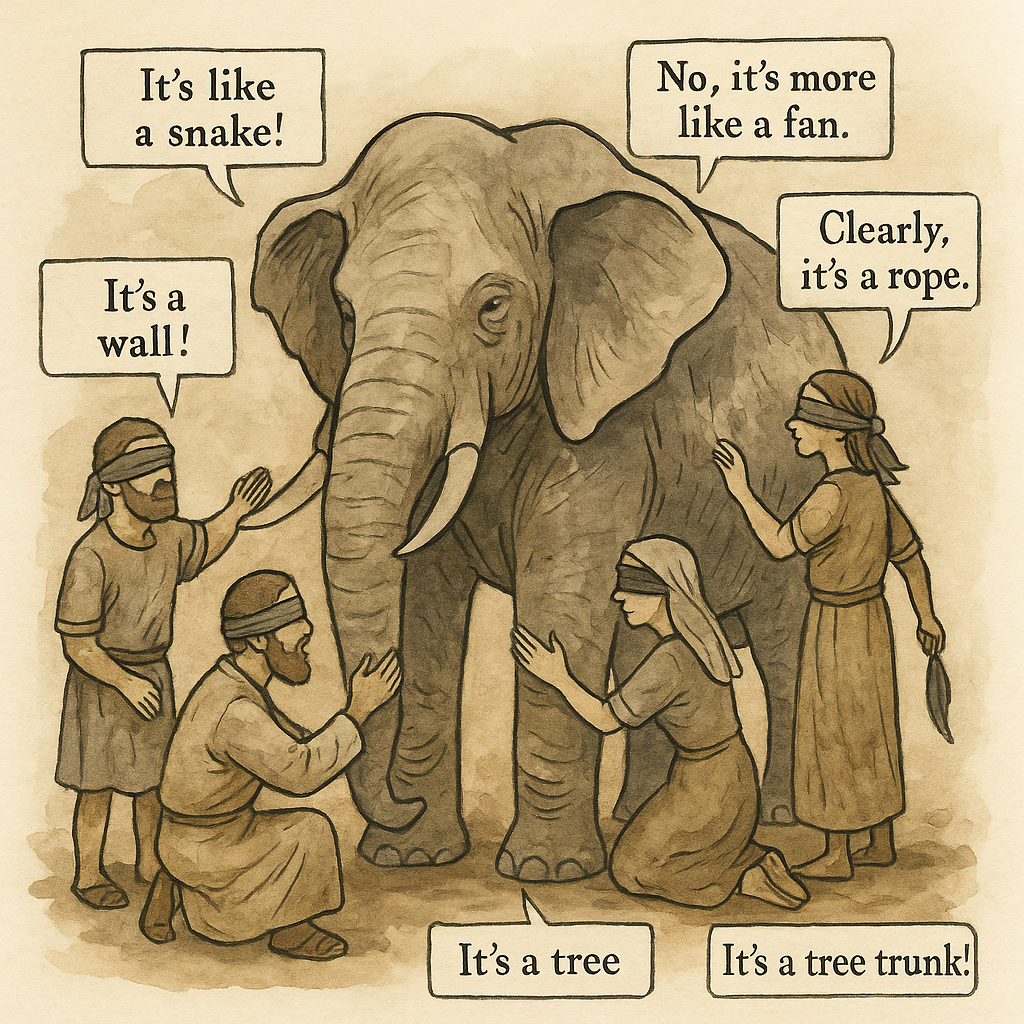
Sure, you’re not in a literal jungle. But if you’ve ever tried to lead armed with only one-liners, productivity hacks, and LinkedIn advice threads… you’ve probably felt just as disoriented.
Because let’s face it: there’s a lot of noise out there. Influencers. Thought leaders. Leadership “gurus.” Even your strange Uncle Rupert—who swears by cold plunges and chatbots. They all promise fast-track hacks to greatness.
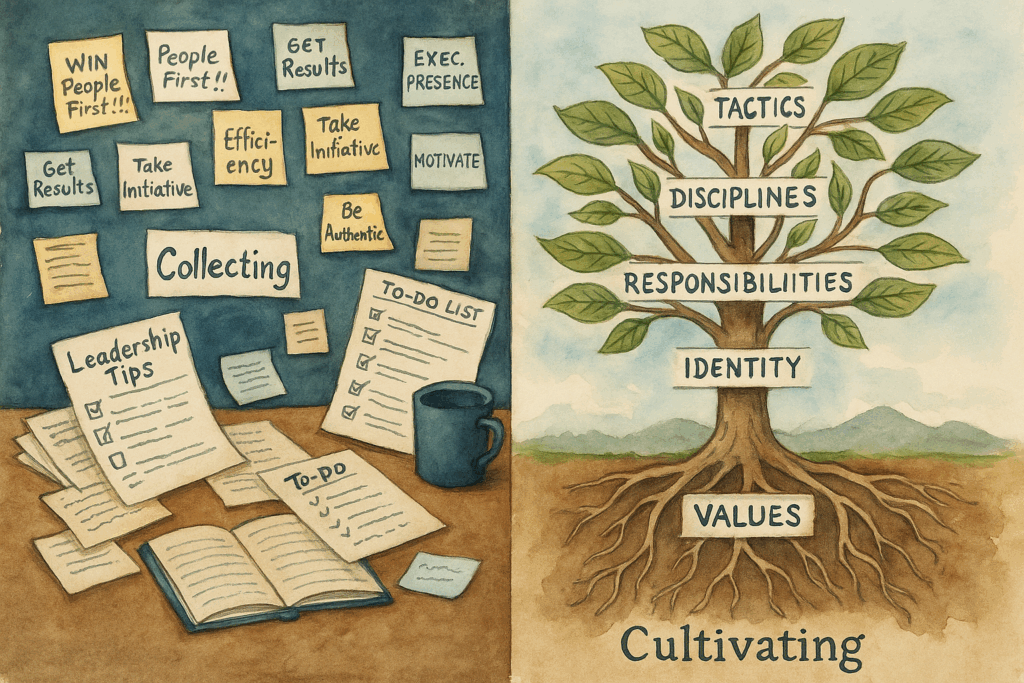
Desperate for direction, you do what anyone would: you start collecting. Taping together slogans, diagrams, and ten-point checklists into something that vaguely resembles a map.
But it’s not a map—it’s a scrapbook of conflicting directions. One corner tells you to “always put people first.” Another says “be ruthlessly efficient.” There’s a dotted line towards “executive presence,” but it dead-ends in to a pile of personality quizzes.
You flip it over, hoping for a legend.
There isn’t one.
This is what passes for leadership guidance in the digital jungle—fragments, slogans, and tactics, all taped together and called a strategy.
A Living Framework: The Leadership Tree
That’s why I built the Leadership Tree.
It’s not a shortcut. It’s not a collage of borrowed wisdom.
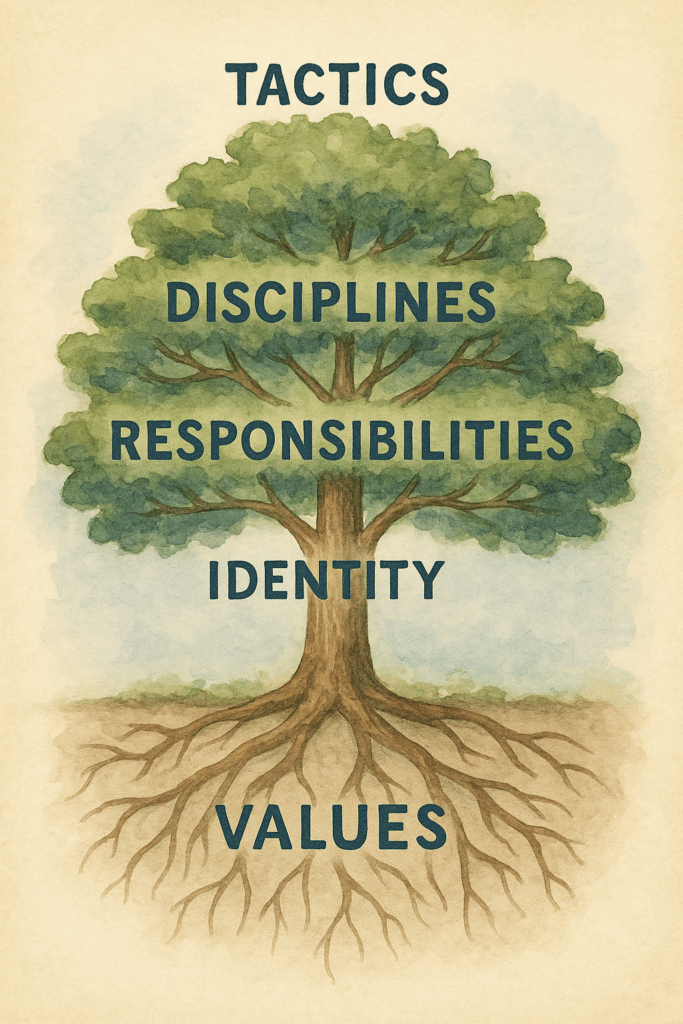
It’s a living model that grows from the ground up—anchored in values at the roots and branching upward to visible tactics at the leaves.
Growing from the Ground Up
Let me be clear: the Leadership Tree isn’t just another trendy framework promising quick fixes. It’s a way to make sense of the noise around you—and finally choose what truly fits you.
It’s not a formula to follow. It’s a framework that gives your leadership room to breathe—and a way to grow with purpose.
Think of it like this: If the jungle is the chaos of leadership advice, the Leadership Tree is your compass—helping you find your direction and avoid the traps.
Start with the Roots
Roots: Your Values
This is where everything begins—not with what you do, but with what truly matters.
When your values are unclear, every tactic looks urgent. You react. You contort. You chase.
But when you lead from your values, you lead with clarity. Your values shape your why—the reason you show up, speak up, or stand firm.
Trunk: Your Identity
From these roots grow the trunk: your identity.
This is how you show up—your tone, your posture, your presence.
Identity is more than your role or personality trait. It’s how your values become visible.
And when your identity is clear, you stop imitating. You already know how to stand firm.
Limbs: Your Responsibilities
The strength you gain from your roots and identity supports three limbs of responsibility:
- To yourself
- To your team
- To your organization
These aren’t interchangeable. They pull in different directions—and when they’re out of balance, you feel it.
Most leadership models talk about responsibility, but few treat it holistically. Some focus entirely on the organization—results, strategy, and scale. Others emphasize followers— motivation, empathy, and empowerment. Both matter. But rarely are they held in tension.
And almost no one talks about the responsibility to yourself.
Not as a wellness buzzword—but as a leadership necessity. Because if you burn out, break down, or lose your way, everyone you lead pays the price.
The Leadership Tree doesn’t ask you to rank your responsibilities. It helps you name them, tend them, and interpret them through your values and identity.
Because the weight of leadership isn’t choosing which limb to grow—it’s learning how to grow all three without tearing yourself apart.
Branches: Your Disciplines
From those limbs grow the branches: your disciplines.
The limbs may carry the weight—but the branches bring shape.
Disciplines are practice patterns that strengthen your leadership. They’re not skills you master once. They’re habits you tend.
Disciplines aren’t trendy. They’re steady. They ask for presence more than performance—and thrive when tended over time.
Leaves: Your Tactics
And at the top of the tree—what most people first notice—are the leaves: your tactics.
Tactics are visible, small-scale, and often seasonal practices you use to implement your disciplines.
- A new meeting format
- A project management tool
- A morning routine
Tactics aren’t bad. But on their own, they’re incomplete.
Without the support of branches, limbs, trunk, and roots—they don’t last.
That’s the problem with most leadership advice: it starts at the leaves.
But the real growth doesn’t start at the top.
It starts from the ground up.
Not Every Leaf Belongs on Your Tree
By now, you’ve probably noticed: most leadership advice doesn’t hand you a real map. It offers slogans. Doodles. Scribbles in the margins of someone else’s journey.
Run the 5 AM Club Through the Tree
Take The 5 AM Club, for example—a popular book by Robin Sharma, promising that waking up early and following a structured routine will unlock personal and professional greatness.
The pitch is clean. It’s attractive. And it feels doable:
- Wake up at 5 AM
- Move for 20 minutes
- Read for 20 minutes
- Journal or Meditate for 20 minutes
You lean in. Maybe this is it. Maybe waking up before dawn is the edge you’ve been searching for—the key to more calm, more control, and more confidence.
But before you commit, you pause—and run it through the Leadership Tree.
Does It Actually Fit?
Tactics (Leaf)
This morning routine is a collection of small, clear, visible actions. That’s what makes it tempting: it feels like momentum you can measure.
But tactics? They’re just the outermost layer of leadership.
Discipline (Branch)
The real question isn’t: Does The 5 AM Club routine work?
It’s: Does it grow from something I’m already tending?
This routine might align with disciplines like Personal Health or Mindfulness. But if those aren’t branches you’re actively nurturing—or if they don’t serve the responsibilities you carry—it becomes another abandoned experiment.
Disciplines aren’t boxes to check off. They’re habits that shape who you’re becoming.
Responsibility (Limb)
You’re clearly trying to show up grounded, focused, and present. That’s part of your responsibility to self.
But here’s the tension:
If you adopt The 5 AM Club from pressure, comparison, or fear of falling behind—what begins as discipline quickly hardens into demand.
You rise early. You check the boxes. You power through. But instead of feeling sharper, you feel thinner—like your soul’s being stretched across too many checklists.
Why? Because you’re chasing performance when what you need is presence
Responsibility to self isn’t about doing more—it’s about doing what truly matters.
And when responsibility loses its roots, it becomes self-neglect.
Identity (Trunk)
Underneath this quest for improvement is a deeper question: Who are you trying to become?
Are you modeling yourself after the hustle-hard, rise-and-grind archetype? Or are you someone who leads from stillness, reflection, and intentionality?
Tactics don’t just change your calendar—they start to reshape your sense of self. And if you’re not careful, you wind up leading like someone else—chasing their rhythm, their goals, their definitions of success.
So ask:
Does this help me lead like myself? Or does it pull me away from who I am when I’m most grounded?
Values (Roots)
And finally, the roots. Before tactics. Before disciplines. Before responsibilities. What do you actually value?
If your core values include Stewardship, Presence, or Discernment… waking up at 5 AM might not serve you.
Because this was never about whether the tactic works.
It’s about whether it works for you.
If the result is more anxiety, more comparison, and less alignment—it’s not nourishment.
It’s erosion.
When a tactic grows from someone else’s values—no matter how sleek or science-backed it seems—it won’t bear fruit in your life.
If it doesn’t start at the roots, it doesn’t belong on your tree.
Use a Rooted Filter, Not a Shiny Shortcut
This is what the Leadership Tree helps you do:
Not: Can I do this?
But: Should I?
Not: Will this make me better?
But: Will this grow from who I already am?
Leadership isn’t about collecting tactics that impress.
It’s about choosing what fits—and pruning what doesn’t.
You’re Not Lost Anymore
The jungle noise won’t stop.
Your inbox will keep filling up.
And the gurus will keep shouting their “5 Easy Steps to Greatness.”
Truthfully, some of those ideas might even be worth exploring.
But you’re not lost anymore. You’re not taping together slogans and hoping they’ll show you the way.
You’ve got a compass now.
A living framework that grows with you—rooted in your values, shaped by your identity, and aligned to the responsibilities you actually carry.
The Leadership Tree doesn’t restrict your exploration.
It refines it—with clarity and confidence.
You’re no longer collecting.
You’re cultivating.
So the next time something shiny shows up in your feed, ask yourself:
- Does this reflect what I value?
- Does this help me lead like myself?
- Does this support what I’ve been entrusted with?
- Does this tend to what I’m already practicing?
If the answer is no—let it go.
That’s not quitting. That’s discernment.
That’s not failure.
That’s leadership.
Rooted. Growing. Intentional. Yours.
Just Plant One Root
Wondering where to start?
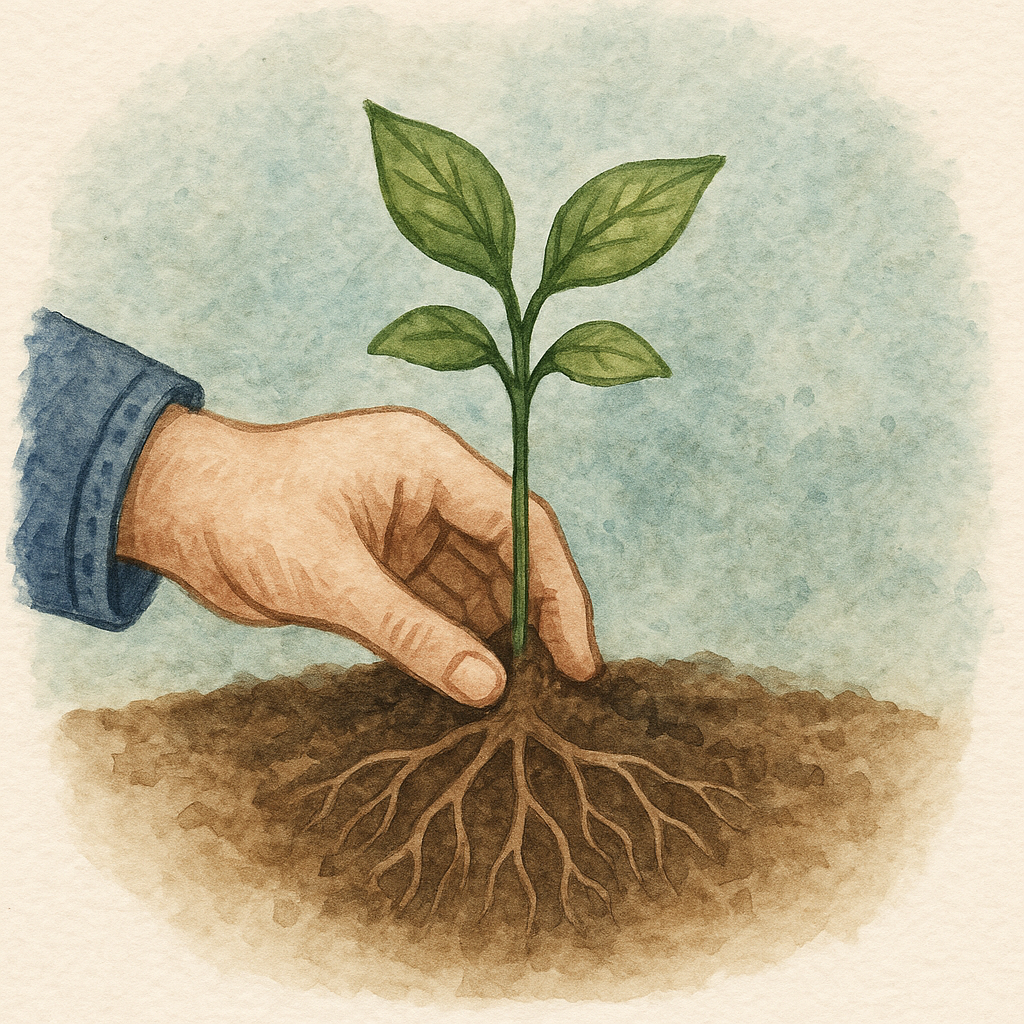
Just choose one value—one root that truly matters to you.
You don’t have to grow the whole tree today.
But once you plant that first root—growth becomes possible.